
Prime Minister Narendra Modi on Friday said his government has carried out major reforms -- including labour reforms and reforms in insurance and defence sectors -- 'in less than 100 days' and stopped reversals Indian economy had been facing.

Former external affairs minister, K Natwar Singh, shares his critique of the Narendra Modi government's foreign policy in this e-mailed interview with Aditi Phadnis. Edited excerpts

Prime Minister Narendra Modi had gone to China with a bagful of initiatives, but not all seems to have been fulfilled given China's reluctance to go the whole hog with him
.jpg)
The decision of the Directorate General of Civil Aviation comes at a time when the UN-body International Civil Aviation Organisation is working on global market-based measures to check aviation emissions.

The country must get its act on global alliances right in order to feed its fuel-hungry economy, points out Subhomoy Bhattacharjee.
'If Islamic extremists regain power in Afghanistan, Pakistan will lead them to Kashmir as a fighting arena again. India needs to fortify Kashmir and prepare against these Islamic extremists before they come again.'

'His negotiations with Idi Amin and his men for compensation for the Indians, who left Uganda, were particularly tough. Apparently, Amin warned him that the body of the British negotiator, who came earlier, was found in a roadside gutter... As Jagat Mehta's special assistant during the last two years of his tenure as foreign secretary, I saw for myself how his conviction, courage and patriotism enabled him to fight against heavy odds, says Ambassador T P Sreenivasan.

52 world leaders, including Narendra Modi, will attend this week's Nuclear Security Summit in Washington, DC. Obama will meet separately only with the Chinese president.
'A three generation US-Pakistan relationship is not likely to be snapped any time soon. All this presents an irritant to an India that wishes to concentrate on economic development,' says Colonel Anil A Athale (retd).

The photo published by the People's Liberation Army Air Force showing a long-range strategic bomber flying within visible range of Yushan, Taiwan's highest mountain, has caused great concern in Taiwan amid debate about whether the mainland will reunify the island by force, state-run Global Times reported.

Since multilateral trade creates a stable, peaceful world, normalisation of bilateral trade between India and Pakistan will start a series of peace building measures, especially along the bordering areas of both states which is the worst affected from the on-going conflict, say Riya Sinha and Shehzad Poonawalla.
'You can see the essential contours of his new Pakistan strategy. Rather than keep engaging with or humouring them, he'd rather work on taking their four biggest supporters -- the US, China, the UAE and later Saudi Arabia -- away from them.' 'In his calculation,' says Shekhar Gupta, 'with the total support of all four of these, Pakistan will be forced to moderate its policies.'
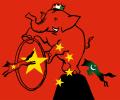
'An elephant has to behave like an elephant and not shy away from confronting the jackals,' argues Colonel (Dr) Anil A Athale.

By contrast, only aeronautical activities are taken into consideration under the dual till principle.
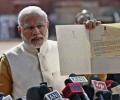
he has to demonstrate the ability of his government to take a quantum leap, almost tantamount to setting the Ganga on fire, in the next six months, if not in 100 days, if the people were to take seriously the cascade of commitments spewing out of the President's address to both Houses of Parliament on June 9, says B S Raghavan. B S Raghavan suggests five practical propositions through which the Modi government can bring in paradigm changes.

'Our equations with China require engagement and not confrontation; its interfaces with Pakistan and with some other South Asian neighbours also add to the complexities,' says Vice Admiral Premvir Das (retd).

As India on Tuesday stole the march over China by launching a mission to Mars, Beijing called for "joint efforts" to ensure peace in outer space.

'Is Xi's China stable?'
'No one can say whether the regime will fall all at once or if its leaders are devising a new solid and competitive -- anything but democratic -- model.' A fascinating excerpt from Francois Bougon's Inside The Mind of Xi Jinping.

Under the policy, the US recognises and has formal ties with China rather than the island of Taiwan, which China sees as a breakaway province to be reunified with the mainland one day.

For a rising country like China with its sights set on global and regional power, any coming together of the US and India is the worst case scenario. Hence, China is concerned with the emerging equations between New Delhi and Washington, says Srikanth Kondapalli.

As Afghanistan gradually realises that there can be no long-term stability in the country as long as Pakistan is involved, the time has come for India to register its solidarity when it would be most appreciated, says former foreign secretary Shyam Saran.

A global group of government anti-money-laundering agencies said that financial institutions have not done enough to police suspicious financial activity by officials at soccer's global governing body FIFA.

Next week, US Secretary of State John Kerry travels to India for the fourth annual US-India Strategic Dialogue

Asserting that it has been a strong champion of equity, India on Thursday said developed countries should compensate developing nations for the effects their greenhouse gas emissions have had on climate.

Swamy said Prime Minister Narendra Modi should convene a conference of "insiders" to draw up a new policy especially after the recent Lakhvi episode.

The national calamity response force, NDRF feels it is time that citizens are "trained" in combating both man-made and natural catastrophes.
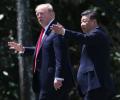
Trump aides, who participated in the two-day talks held at the US President's Mar-a-Lago resort in Florida, described the meetings as productive and said the two leaders exhibited "positive" chemistry.

The question really is whether the US can be persuaded to embark on a path of calibrated and stronger sanctions on Pakistan.
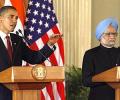
National Shiv Shankar Menon asserts that all is well in the India-US relationship. Aziz Haniffa reports from Washington, DC.

'If the dimensions of the strategic partnership worked out by India and the US seem like a grand alliance targeted at you-know-who, China had better realise that it has fathered it,' says B S Raghavan, a long time observer of China.
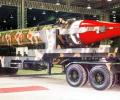
For the world and India, one of the most enduring challenges of the times is for Pakistan's nukes to be neutralised, before they are ever used by the State, their sponsored non-State actors or any rogue elements from the many terror tanzeems dotting Pakistan's unstable landscape, says Lieutenant General Kamal Davar (retd).

Theoretically, there is an inverse relationship, but other factors need to fall in place for it to work well this time

'Clearly, from the Indian viewpoint, the US retrenchment from Asia cannot be happening as good news.' 'The abandonment of the US' pivot to Asia exposes the US-Indian partnership to be a mere transactional relationship,' says Ambassador M K Bhadrakumar

The visit of Park Geun-Hye to India, though a symbolic one, will certainly give a further impetus to the strategic partnership between the two countries says Rup Narayan Das.

PM Modi seems to be gradually ending India's strategic ambiguity
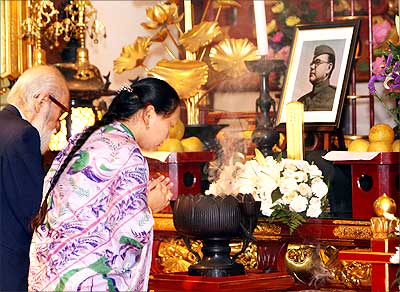
'The extended Bose family is insisting that the Japanese government must release all the information they have on Bose's ashes. It cannot be forgotten that Bose was in Japanese care when his 'death' occurred. Ultimately, it is the Japanese who hold the secret about what happened to him.'

It seems China is ready to cooperate with India in the central Asian region through the SCO framework, the reasons for which are manifold, says Sana Hashmi.

While RBI is yet to come out with a clear regulatory framework for bitcoins, which have been gaining currency across the world over the past few months, it has issued an advisory cautioning general public against use of bitcoins and other virtual currencies.

'The ISI has given a stunning display of its capacity to do with impunity what it likes within Kabul. Incensed over the triumphalism of the hardliners in Kabul, the ISI has hit out; it is a typical ISI reflex action that Indians are familiar with,' says Ambassador M K Bhadrakumar.

'Whether it's investments in Kashmir, building naval facilities, or selling top-of-the-range military equipment, Pakistan could well benefit more under Xi's watch.' 'Do Chinese concerns about the 'Islamisation' of Pakistan give it pause about how quickly to move forward with security and economic projects? At the moment the indication is quite the opposite: China is doubling down on its support to Pakistan, partly because of its fears about where the country is headed.'
